Brisket 101: Everything You Need to Know About Beef Brisket

Before you fire up the smoker, start here. This guide covers the fundamentals — what brisket is, how it's cut, and what to look for when buying. For step-by-step smoking instructions, visit our complete How to Smoke a Brisket guide.
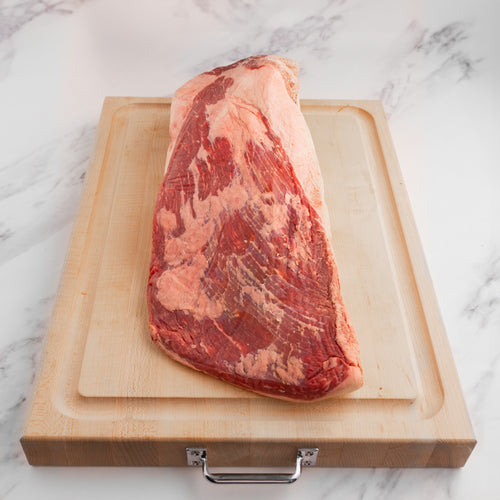
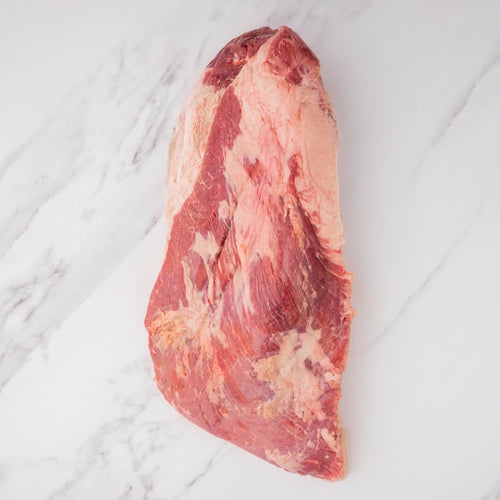
Snake River Farms offers a variety of whole briskets. A whole brisket is identified as a 120 beef brisket, deckle-off, boneless by the North American Meat Processors Association (NAMP). It is not uncommon to hear a whole brisket referred to as a full packer or packer brisket.
Briskets are the chest or pectoral muscles of beef cattle. There is one brisket per animal that is separated into two whole briskets. And barbecue mythology aside, there is no discernible difference between the right and left briskets. Each brisket is made up of two separate muscles. The deep pectoral muscle (pectoralis profundus) is the largest section and is commonly referred to as the "flat". The second section is the smaller superficial pectoral muscle (pectoralis superficialis) or what is referred to as the "point".
Snake River Farms American Wagyu briskets are generally larger than those of conventional cattle. They are offered in a variety of grades and sizing ranging from 9 pounds to over 22 pounds. No matter the size you choose, a full packer brisket is a large cut of beef and makes a perfect meal when serving a crowd.

Why Snake River Farms American Wagyu?
Just like all our offerings, American Wagyu briskets have more internal marbling than conventional beef, including top-rated USDA Prime. The intense levels of marbling result in a rich brisket, overflowing with juiciness and flavor. Our highly marbled briskets are the not-so-secret weapon for many competitive barbecue teams and world-champion pit masters. Dubbed the "Winningest Brisket in BBQ," every major world-championship BBQ Contest has been won using a Snake River Farms American Wagyu Brisket.
Tuffy Stone, 6-time World BBQ Champion, award winning chef and celebrated pit master, says our American Wagyu briskets are “the perfect ingredient to give you the edge you need in competition or in the backyard. Starting with the best products sets you up to win. Snake River Farms fits right into my way of doing things, providing the best experience with the best products.”
How long does it take to smoke a brisket?
Time is quite possibly the most important ingredient when smoking a brisket — it is an all-day (or all-night) task and not something to be rushed. The two most common methods are the classic low and slow cook (10 to 14 hours for a 15-pound brisket) and the hot and fast method (approximately 5 to 6 hours). For full temperature targets, timing, and step-by-step instructions for both methods, see our complete How to Smoke a Brisket guide.
Prepare the Brisket
While prep and smoking the brisket can be a bit intimidating, taking the process one step at a time is a clear path to success. Follow the steps below to get started, and watch acclaimed pit master and 15-time world barbecue champion Darren Warth, share his tips on how to trim and smoke a brisket from start to finish in our Butcher Shop Bootcamp Video: How to Smoke a Backyard Brisket with Darren Warth.
Brisket Trimming
There are varying philosophies on how to trim a brisket, but the general idea is always the same: create a uniform size and smooth surfaces so your brisket cooks evenly on the smoker. When trimming a brisket, you'll focus on the point and flat muscles. Trim while the brisket is cold — the meat and fat stay firmer and the process is easier. Don't throw away your trimmings — see our guide on what to do with brisket trimmings for ideas.

Brisket Rubs
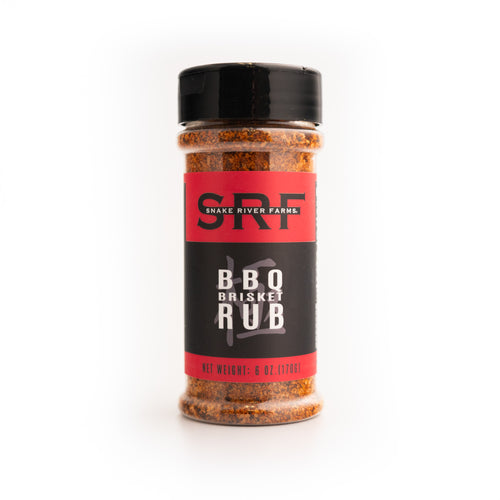
Rubs can be applied up to 24-hours prior to cooking and are an integral part in the cook process. A classic Texas brisket rub calls simply for salt and pepper, and while delicious it’s also great to add layers of flavor to your cook. To keep it super simple, we suggest our signature SRF BBQ Brisket Rub which we created with the help of longtime friend and award winning BBQ pit master, Steph “the genie” Franklin.
It’s also fun to experiment by creating a DYI rub including your favorite flavors. Popular rub ingredients are salt, pepper, paprika, garlic, onion, and sugar.
It is not uncommon to see a viscous or sticky ingredient such as oil or yellow mustard used as a binder to help the rub to adhere to the brisket. Using a binder does not really add to the final flavor; and when applying a binder to a brisket that has started to come up to room temperature, the rub sticks easily to the moist surface of the brisket.
No matter what rub you use, apply it to all surfaces of the brisket (even the fat). Using your hands or a shaker, put some distance between the seasoning and the brisket. Then, let it rain. Your goal is to have an even layer of rub on the entire brisket.
After the brisket has been trimmed and seasoned, it can rest safely, covered in refrigeration, for up to 24 hours. Prior to adding the brisket to the smoker, remove it from the fridge and allow it to rest for at least 1 to 2 hours at room temp to prepare it for the smoker. By adding a brisket that is close to room temperature to the smoker, it prevents a sudden drop in temperature of the smoker. A cold brisket in the smoker will result in a longer cook time.
Fat Side Up or Down?
This question comes up a lot in brisket cooking, and like so much of brisket lore, there are many opinions. A common thought is to cook fat side up because the cap will melt and infuse the meat with rich, rendered fat. However, many beef experts point out the muscle fibers of brisket are too tight to allow this to happen.
We've tested both ways and relied on feedback from many pit masters, and we find our best results come from cooking the brisket fat side down. Kettle, Kamado and pellet smokers deliver most of the heat from the bottom, thus placing your brisket fat side down protects the meat from more direct heat and creates a more uniform bark.

How to Slice a Brisket
Like all beef, a brisket is best when sliced against the grain — this shortens the muscle fibers and creates a texture that is tender and easy to eat. A brisket has two primary pieces, the point and the flat, and the muscle fibers run in different directions in each, so take note of the grain before slicing. Separate the flat from the point, start with the flat and cut even slices, then rotate the point 90 degrees so it runs parallel to you and slice.
The point can also be cubed to make Brisket Burnt Ends, a specialty originating in Kansas City.
Learn How to Make Brisket Burnt Ends →
The Low and Slow Brisket Method
Low and slow is the most traditional approach — set your smoker to 250°F and let time do the work. Load the brisket fat side down once the smoke turns from white to blue-gray, then resist the urge to open the lid for the first 3 hours. Around the 3 to 4 hour mark, mist lightly with water, beef broth, or apple juice. Expect a stall in the 150°F to 160°F range — this is completely normal. Wrap on color when the bark turns a deep mahogany, and pull on feel when the probe slides through the flat like butter, typically between 198°F to 206°F. Rest for a minimum of 2 hours before slicing.
Brisket Internal Temperature Guide →
The Hot and Fast Brisket Method
Hot and fast cuts the cook time roughly in half by running your smoker at 300°F or higher — ideal for drum smokers, offset smokers, and wood pellet grills. Place the brisket fat side down, misting every 30 minutes with water, beef broth, or apple juice to build bark and add moisture. Wrap on color the same way you would low and slow, and pull on feel when the probe slides clean, typically between 205°F to 210°F. Follow the same resting and slicing steps above.

Which Brisket Is Right for You?
Whether you're smoking for a backyard crowd or competing on the circuit, the brisket you start with sets the ceiling for your results.
-
Snake River Farms American Wagyu briskets offer the highest levels of intramuscular marbling available — more forgiving on a long cook, richer in flavor, and the choice of world-champion pit masters.
-
Double R Ranch USDA Choice and Prime briskets deliver excellent quality and consistency at a more accessible price point, aged at least 21 days for rich beef flavor and tenderness.
Both ship frozen and are ready for your smoker. The only question is how high you want to set the bar.
|
Want authentic Texas brisket without the smoke?
|
Featured Products